



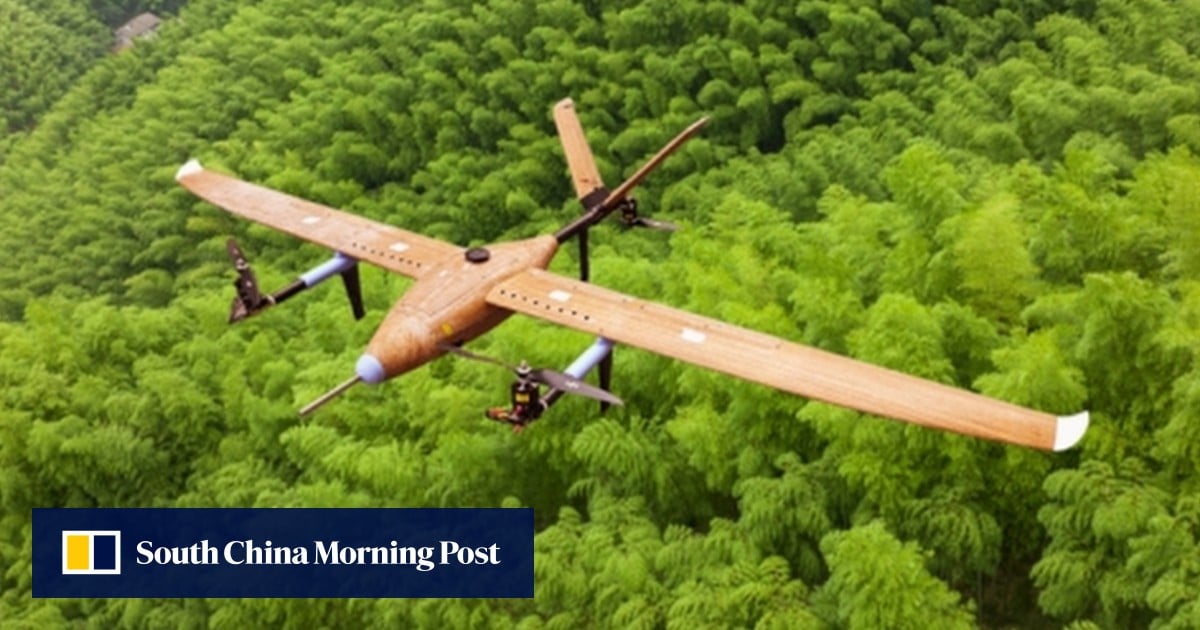

Unlike conventional airframes made of composite materials, bamboo structures introduce low-frequency vibrations – typically in the 8–20 hertz range – that standard flight controllers struggle to handle.
According to the team’s paper, published on February 28 in Heilongjiang Science, existing commercial flight controllers are either closed-source and inflexible, or open-source but poorly adapted to local development needs, limiting the industrialisation of bamboo-based UAVs.
More significantly, they redesigned the control algorithms to match bamboo’s structural properties.
By tuning an extended Kalman filter and leveraging bamboo’s natural vibration-damping characteristics, the system reduces control latency from 15 to 20 milliseconds to as low as 8 to 10 milliseconds – improving responsiveness while maintaining stability.
#China #team #releases #worlds #bamboo #drone #flight #control #software #free

 English
  简体中文
简体中文  繁體中文
繁體中文  Français
  Español
  Deutsch
  Русский
  日本語
日本語  한국어
한국어  العربية